

2026 Year-End Market Outlook: A Maturing Bull Market and What Investors Should Know Heading into 2027
Authored by: Chris Vidler, CFP®, CIMA®
As we approach the final months of 2026, the stock market continues to demonstrate remarkable resilience. Despite persistent inflation, higher interest rates, geopolitical tensions, and economic uncertainty, U.S. stocks have continued to advance. Through September, the S&P 500 had gained approximately 12% for the year, extending a bull market that began in October 2022.
Yet beneath the surface, today's market presents some unusual characteristics. Much of its growth has been driven by a relatively small number of large companies, while other areas of the market have experienced more modest gains. Meanwhile, the approaching midterm elections introduce another source of uncertainty for investors.
At Concentric Wealth Partners, we believe three themes are particularly important as we look toward 2027: where we stand in the current bull market, what makes today's market different, and what history tells us about investing during midterm election years.
Where Are We in the Bull Market Cycle?
The current bull market began in October 2022, following a difficult year in which inflation surged, interest rates rose sharply, and stock prices declined. Since then, the S&P 500 has more than doubled, marking an impressive recovery and a strong period for investors.
Now entering its fifth year, the natural question is whether this bull market is approaching its end.
While history provides perspective, there is no predetermined lifespan for a bull market. Some last only a few years, while others continue for considerably longer. Rather than focusing solely on how long the market has been rising, we believe it is more important to understand what is driving those gains.
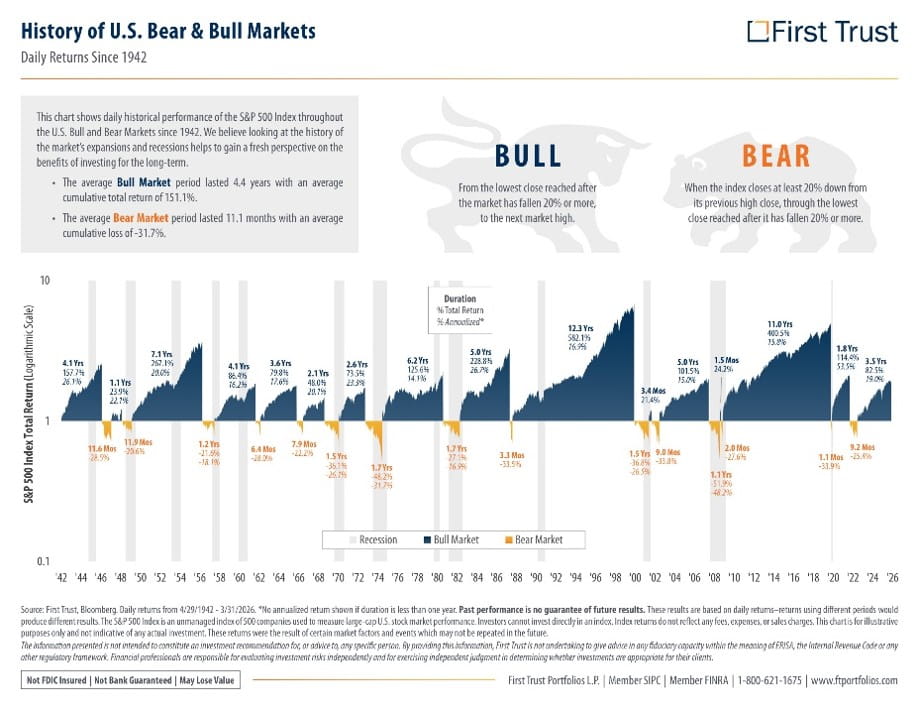
Chart: Historical U.S. bull and bear market cycles, showing the length and magnitude of previous market advances and declines. Source: First Trust.
As the chart illustrates, bull markets have historically lasted considerably longer than bear markets, although the duration of each cycle has varied significantly. The important takeaway is that market declines are a normal part of investing, and a bull market does not end simply because it has reached a certain age.
One of the most encouraging aspects of the current market is the strength of corporate earnings. Simply put, companies have continued to grow their profits, helping support higher stock prices even as borrowing costs have increased. Investment in artificial intelligence, technology infrastructure, and business productivity has been particularly important to this growth.
The broader economy has also remained resilient. Consumer spending continues to support economic activity, businesses are investing in future growth, and the labor market has held up despite challenges.
However, the market is not without risks. Stock prices have risen substantially, and investors are paying relatively high prices for the profits companies are expected to generate. This means future market gains will increasingly depend on businesses continuing to deliver strong results.
Inflation and interest rates also remain important considerations. With inflation still above the Federal Reserve's target, policymakers face the challenge of controlling prices without weakening economic growth. Higher interest rates can make borrowing more expensive for households and businesses, while also creating competition for stocks from investments such as bonds.
Our view is that the bull market may be maturing, but that does not necessarily mean it is ending. Corporate earnings and continued economic growth provide reasons for optimism, although the path forward may be less predictable than investors have experienced in recent years.
A Market Driven by a Few Big Companies
The stock market has changed a lot over the past few years. Most of the gains that investors have made have come from just a handful of companies, like Microsoft, Amazon, Alphabet, and Apple. These companies have been around for a while, but they have grown very large in recent years. Because these companies are so big, they have a greater impact on the overall stock market than smaller companies. Even though the S&P 500 index tracks 500 different stocks, the largest companies have the biggest influence on its value.
According to J.P. Morgan Asset Management, the ten largest companies represented approximately 41% of the S&P 500's total value in October 2026, compared with roughly 20% during much of the past four decades. In other words, just ten companies now account for nearly half of an index that includes hundreds of businesses.
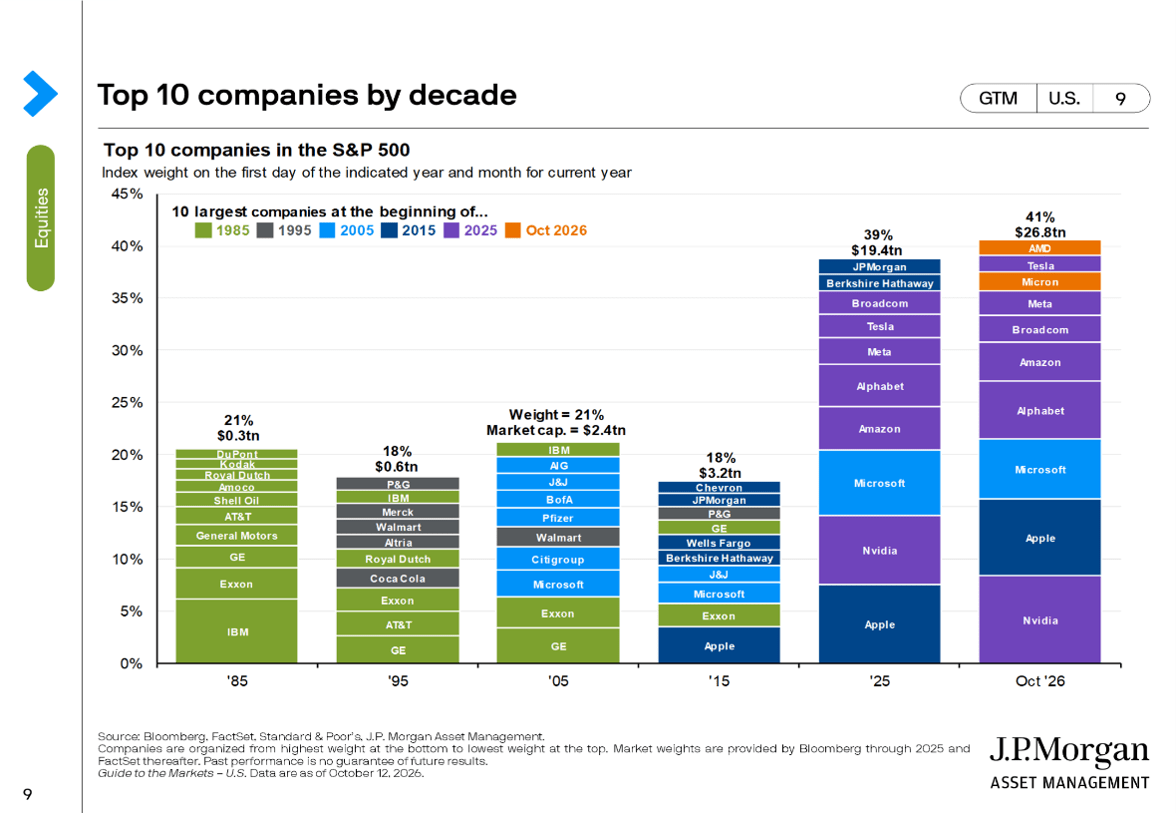
Chart: Percentage of the S&P 500 represented by its ten largest companies across historical periods, highlighting the increase to approximately 41% in October 2026. Source: J.P. Morgan Asset Management, Guide to the Markets, page 9.
Much of this concentration reflects the remarkable success of large technology companies, particularly those benefiting from the growth of artificial intelligence. Importantly, these companies are generating substantial profits, suggesting their success is supported by more than investor enthusiasm alone. Still, this concentration creates an important consideration for investors. When a small group of companies accounts for such a large portion of the market, their performance can have an outsized impact on overall returns. It also means that a rising S&P 500 doesn't necessarily indicate that most stocks are performing equally well.
In fact, the difference has been substantial during this bull market. While the largest companies have delivered extraordinary returns, the average stock has experienced considerably more modest growth.
We continue to believe technology and artificial intelligence offer meaningful long-term opportunities. However, history reminds us that the companies leading the market today will not necessarily be the same ones leading it tomorrow. As businesses across the economy begin using new technologies to improve productivity and profitability, opportunities may increasingly extend beyond today's largest companies.
This is one reason we believe diversification remains important. Owning a thoughtful mix of investments allows investors to participate in today's market leaders while maintaining exposure to other companies and industries that may drive future growth.
Midterm Elections and Market Volatility
As November's midterm elections approach, political uncertainty is likely to remain a topic of conversation for investors.
Historically, midterm election years have often been associated with more subdued stock market performance and increased volatility, particularly during the months leading up to Election Day.
This is understandable. Elections create uncertainty surrounding taxes, government spending, regulation, and other policies that can influence businesses and financial markets.
However, history offers an interesting perspective on what happens once elections are over.
According to research from BlackRock, the S&P 500 has historically gained an average of approximately 14% during the six months following midterm elections since 1970. Markets have often begun improving even before Election Day as uncertainty surrounding the outcome starts to fade.
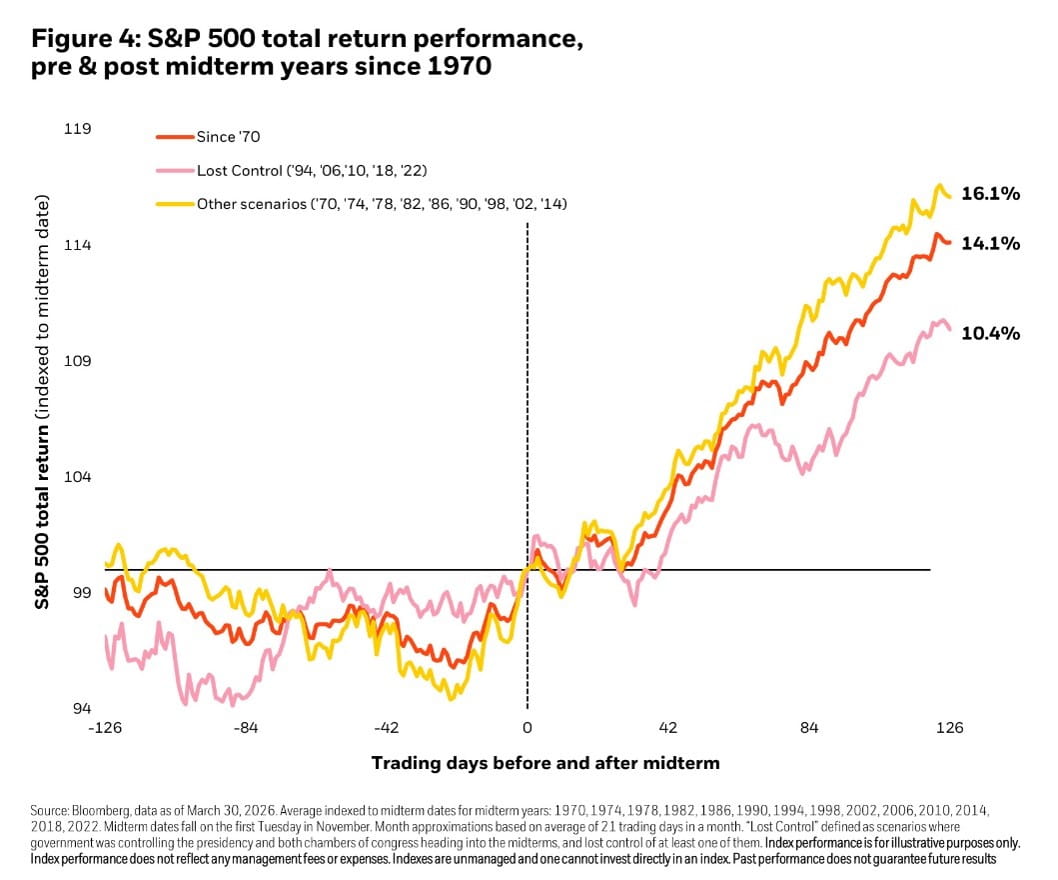
Chart: Average S&P 500 performance in the months leading up to and following midterm elections since 1970, highlighting the historical tendency for markets to strengthen after Election Day. Source: BlackRock, Investment Directions, Figure 4.
As the chart illustrates, the market has historically experienced a stronger period following midterm elections than in the months preceding them. While every election cycle is different, this pattern suggests that the removal of political uncertainty can sometimes provide a favorable backdrop for investors.
Nevertheless, history is not a guarantee of the future. Economic conditions change, and the performance of the stock market is largely determined by the economy and corporate profits, rather than political outcomes. One lesson from history is that markets have successfully navigated periods of both Democratic and Republican leadership. Attempting to predict market performance based solely on election outcomes has rarely been a dependable long-term investment strategy. Instead of reacting to the political landscape, we think investors should stay true to their investment discipline and remain focused on their long-term financial goals.
Looking Ahead: Maintaining Perspective
As we move toward 2027, our outlook remains cautiously optimistic. The economy continues to expand, corporate profits remain strong, and new technologies are creating opportunities for businesses across a variety of industries. At the same time, elevated stock valuations, concentrated market leadership, and uncertainty surrounding inflation and interest rates suggest investors should remain prepared for periods of volatility.
Market corrections are a normal and unavoidable part of investing, even during healthy bull markets. In many ways, volatility is the price of admission investors pay for participating in the long-term growth of financial markets.
At Concentric Wealth Partners, our focus remains on building diversified portfolios, managing risk, and making thoughtful investment decisions that support each client's financial plan.
We cannot predict exactly when the next market decline will occur or how long the current bull market will continue. What we can do is maintain a disciplined investment approach designed to navigate changing market conditions while remaining focused on long-term opportunities.
Ultimately, successful investing is not about predicting every market movement. It is about having a thoughtful plan and the discipline to stay committed to it through both favorable and challenging markets.
The opinions expressed are those of Christopher Vidler and Eric Van Der Hyde as of the date stated and are subject to change. There is no guarantee that the forecasts made will come to pass. This material does not constitute investment advice and is not intended as an endorsement of any specific investment or security. Information and opinions are derived from proprietary and non-proprietary sources. Opinions are not necessarily those of Raymond James.
Please remember that all investments carry some level of risk, including the potential loss of principal invested. Diversification and strategic asset allocation do not assure profit or protect against loss.
The S&P 500 is an unmanaged index of 500 widely held stocks that is generally considered representative of the U.S. stock market. Keep in mind that individuals cannot invest directly in any index, and index performance does not include transaction costs or other fees, which will affect actual investment performance. Individual investor's results will vary.
