

Why Does Saving for College Feel Like a Moving Target?
Authored by: Cam Sickell, Virginia Tech: Class of ‘27
Saving for School Isn’t Always as Clear as it Seems
Like most savings goals, parents approach saving for college with a simple assumption: make consistent contributions over time, stay disciplined, and allow market growth to help cover future education expenses. While long-term investing can be an effective way to prepare for the cost of tuition, rising total costs of attendance present a challenge many families overlook.
The question is no longer simply whether your investments are growing.
The question is now whether your savings are growing at a pace that may help offset increases in college costs over time.
To better understand this challenge, it helps to look at how the cost of attendance has changed over time. While most families pay close attention to broad market performance, the cost of the goal itself often receives less attention. Tuition, room and board, fees, and other education expenses have continued to rise over the years, increasing the amount families ultimately need to save. The chart below shows how total costs of attendance have changed across several Virginia public universities.
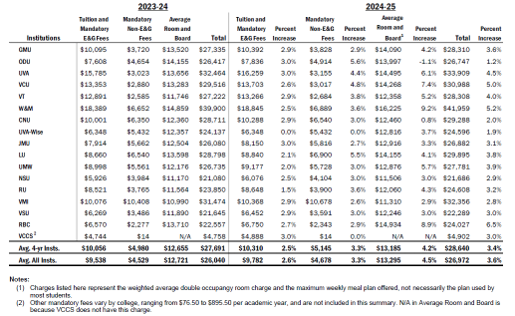
Source: Appendix D-1, VA 2024-25 Tuition and Fees Report.
The data highlights an important reality for families saving for college: the cost of attendance rarely stands still. Across Virginia's public universities, total costs increased by an average of 3.4% for the 2024-25 academic year, with several institutions experiencing even larger increases. While a few percentage points may seem manageable in a single year, repeated increases over time can substantially raise the amount families ultimately need to save. The challenge can become even more pronounced during periods of market volatility. In years when investment returns disappoint or markets decline, families may find themselves losing ground on both sides: portfolio growth slows while education costs continue climbing. As a result, college planning can feel like trying to hit a moving target.
The Unseen Costs
According to the Virginia 2024-25 Tuition and Fees Report, room and board charges averaged $13,185 at baccalaureate institutions, an increase of 4.2% ($530).
While tuition often receives the most attention during the college planning process, housing and meal costs can have an equally meaningful impact on a family's total education budget. In fact, room and board now represent nearly half of the average total cost of attendance at Virginia's public four-year institutions.
Take William & Mary as an example. During the 2024-25 academic year, average room and board costs increased 9.2%, compared to a 2.5% increase in tuition and mandatory educational fees. For families saving years in advance, these types of increases can be difficult to predict. Even when tuition growth remains relatively modest, rising housing and dining expenses can significantly increase the amount ultimately needed to fund a college education.
Additionally, these expenses can also be more difficult to anticipate than tuition increases. Local housing markets, inflation, and university dining costs can all influence the amount students ultimately pay. For example, changes in local housing markets can increase off-campus rental costs for students even when tuition growth remains relatively modest, contributing to a higher overall cost of attendance.
The impact of rising education costs becomes more apparent when viewed over a longer period. The chart below compares the total cost of attendance at Virginia public institutions against per-capita disposable income over the last several decades. While household income has generally increased over time, college costs have consumed a larger share of those resources, illustrating the affordability challenges many families face today.
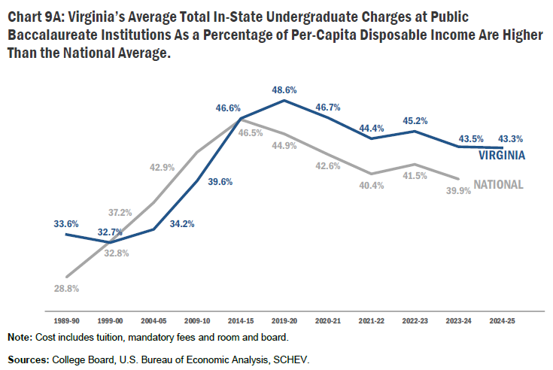
Source: Chart 9A - VA 2024-25 Tuition and Fees Report
While the trend has cooled off in recent years, the overall story remains unchanged. The cost of attending a Virginia public university today represents a significantly larger financial commitment than it did for prior generations. In fact, the report notes that total charges at Virginia's public baccalaureate institutions reached a historical high of 48.6% of per-capita disposable income in 2019-20 and remain well above historical levels today.
For families saving for a child's education, this trend reinforces the idea that college has become increasingly expensive relative to household resources. While incomes have generally risen over time, the cost of attendance has consumed a larger share of those resources than it did for previous generations. For savers, this means future education expenses may require a greater level of preparation than many parents experienced when they attended college themselves.
What can families do to plan for inflating college costs?
- Start Early
Few forces in the market are as powerful as compounding. Starting early gives your savings more time to grow and can significantly reduce the amount you need to contribute later to achieve the same goal.
- Utilize Tax-Advantaged Savings Strategies
Tools such as 529 plans can help maximize the growth of education savings by allowing investments to grow tax-deferred and be withdrawn tax-free for qualified education expenses.
- Ensure Proper Asset Allocation
While age-based and target-date portfolios are designed to reduce risk over time, some may sacrifice potential growth. A strategy that balances risk management with continued growth exposure may help families build greater college savings and better navigate the increasing cost of education.
The cost of college may be a moving target, but that doesn't mean families are powerless. By starting early, utilizing available tax advantages, and ensuring investments remain aligned with long-term goals, families can put themselves in a stronger position to fund future educational opportunities.
Sources:
State Council of Higher Education for Virginia, 2024–25 Tuition and Fees Report, 2024.
Opinions expressed in the attached article are those of the author and are not necessarily those of Raymond James. All opinions are as of this date and are subject to change without notice. Investing involves risk and you may incur a profit or loss regardless of strategy selected. Prior to making an investment decision, please consult with your financial advisor about your individual situation.
529 plans come with fees and expenses, and there is a risk they may lose money or underperform. Tax implications can vary significantly from state to state.
